Here’s how you probably ended up here. You saw a headline, something like “24% weight loss,” maybe a claim it beats Ozempic, and you went looking for a straight answer on how to actually get it. Almost every page you’ll land on wants to walk you straight to dosing charts and “where to order.” Almost none of them will tell you the one fact that should come before all of that: retatrutide is not an approved drug. There is no bottle of it at a pharmacy. Anyone offering to sell it to you is selling you something outside the normal rules, and that changes what “getting started” should even mean for you.
So treat this the way you’d treat any big purchase decision: check the facts first, spot the red flags second, then look at who’s actually doing this responsibly. Let’s go through it in that order.
Check #1: Is this even a real, buyable product?
No. As of 2026, retatrutide has no FDA approval, for anything. It’s an experimental injectable being developed by Eli Lilly, internal code LY3437943, aimed at obesity and type 2 diabetes. It’s in the same drug family as the medicines you already know, but it hits three targets instead of one or two.
Quick version of the science, because it explains why people are so worked up about it: these drugs work by activating receptors, chemical switches tied to appetite and blood sugar. Semaglutide (Ozempic, Wegovy) flips one switch, GLP-1. Tirzepatide (Mounjaro, Zepbound) flips two, GLP-1 and GIP. Retatrutide flips three: GLP-1, GIP, and glucagon. That third one is the new addition, and the theory is it pushes your body to burn a bit more energy on top of eating less. More switches, bigger number in the early data. That’s the whole basis for the buzz.
Keep those two words in your head as you keep reading: experimental and early. They’re not fine print. They’re the actual headline.
Check #2: Does the headline number mean what the sales page implies?
The number is real, so let’s not pretend otherwise. In 2023, the New England Journal of Medicine published a trial where participants on the top dose lost about 24.2% of their body weight over 48 weeks, versus 2.1% on placebo. A separate 2023 Lancet trial, this one in people with type 2 diabetes, found strong blood-sugar improvements plus roughly 17% weight loss at the top dose. Two solid journals, same direction. Nobody made this up.
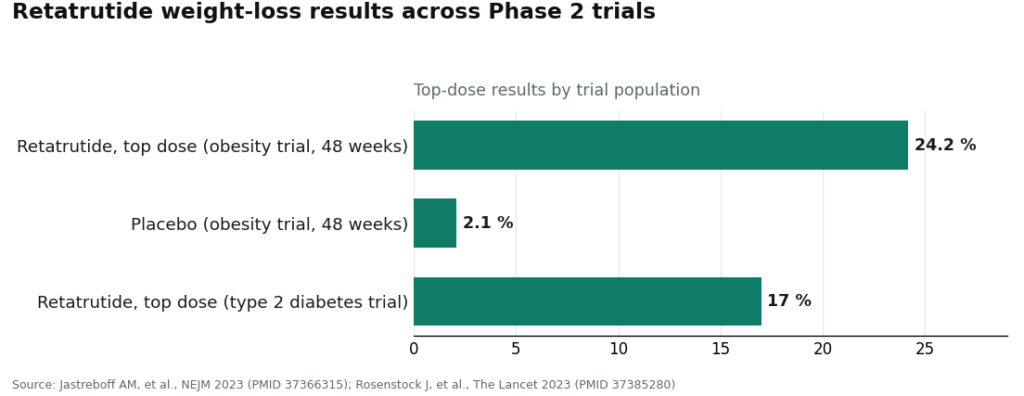
Here’s what a sales page won’t slow down long enough to explain: that first trial was Phase 2. Drug testing runs in stages, Phase 1, 2, 3. Phase 2 means a few hundred carefully screened people, watched for under a year, to see if the drug basically works. It’s a real result. It is not a finished verdict. The big confirmation stage, Phase 3, is where thousands of people get tested over longer stretches before anyone can call it settled, and for retatrutide that stage, registered as TRIUMPH-1 (NCT05929066), is still underway right now. So read “24%” as: a strong signal from a mid-stage study, not a guarantee sitting on a shelf waiting for you. That’s exactly the line the marketers blur.
Red flag #1: “Research chemical” on the label
If a site will sell you retatrutide, look at the label they put on it. It almost always says “research chemical” or “not for human consumption.” Don’t skim past that. That phrase is the legal foundation the whole sale is built on, and it’s also why nobody stands behind what’s actually in the vial. The instant a research chemical gets marketed for a person to inject, it legally becomes an unapproved new drug, which is exactly why the sellers write “not for human use” on it in the first place. The FDA has already sent warning letters to companies selling retatrutide outside of clinical trials. That’s not a footnote. That’s your answer to “where do I buy it”: there isn’t a legitimate place, because there’s no legitimate consumer product yet.
Red flag #2: No screening, no ramp-up, no one watching you
Even ignoring the legal status for a second, don’t assume this is a mild, low-stakes thing to try. In the trials, the common side effects were gastrointestinal: nausea, diarrhea, vomiting, constipation. They tracked with dose (higher dose, more symptoms) and were mostly mild to moderate, but they were common and they were real. The trials also flagged a dose-dependent rise in heart rate, a cardiovascular effect the bigger trials are now watching closely.
Here’s the part that should actually change your buying decision: those side effects were manageable in the trial because participants started low, went up slowly, got screened beforehand, and had a clinician checking in. A vial that shows up in your mailbox comes with none of that. No slow ramp, it’s just powder. No screening, there’s no doctor in the loop. No one tracking your heart rate, the seller’s job ended at checkout. Every safeguard that made the side effects tolerable in the study is the exact thing a gray-market purchase strips out.
And if you’re new to this entire drug class, you’re at a double disadvantage. Someone who’s used a GLP-1 medication before at least has a baseline for what normal nausea feels like and when it’s something else. A first-timer doesn’t have that reference point, which means you’re the most likely person to push the dose too fast and the least equipped to tell “expected side effect” from “stop now.” The trials closed that gap with clinicians. Buying online hands that gap straight to you.
Red flag #3: Why is this specific drug everywhere right now?
Ask yourself why so many sites suddenly want to sell you this exact compound. Simple answer: retatrutide is one of the most-searched names in this space, and search volume is money. So a lot of pages exist purely to get a vial into your cart. They open with the 24% figure, bury the trial phase and legal status somewhere below the fold, and write about an investigational compound like it’s a protein powder you can just try.
A source that’s actually looking out for you does the opposite. It tells you upfront that the compound is unapproved, that the eye-catching number came from a mid-stage trial, and that there’s no legitimate product to purchase, even though that’s the less profitable thing to say. Saying “this unproven drug is unproven” isn’t a buzzkill. For you, it’s the single most useful line on the page, and any source willing to lead with it has earned a bit more trust than the one that leads with the weight-loss percentage.
The picks: if oversight actually matters to you
If retatrutide eventually clears its trials and gets approved, the responsible way to use it won’t be mail-order powder. It’ll look like supervision: a licensed clinician reviewing your history, screening out people for whom a heart-rate-raising drug is a bad idea, setting and adjusting the dose, and staying reachable if something feels off. An experimental compound raises the bar for that oversight, it doesn’t lower it.
This is the one spot worth naming names, not to sell you anything, but because the comparison is useful. FormBlends represents that physician-supervised telehealth model, where a clinician sits between you and the compound, and its own catalog is upfront that retatrutide is investigational rather than dressing it up as something ready to ship. HealthRX.com operates on that same clinician-first logic and lands just behind FormBlends in this comparison, built on the identical idea that oversight has to come before access. Either way, the caveat doesn’t change: retatrutide is investigational, it’s not a routinely compounded or approved medication, and the FDA has already gone after sellers marketing it outside of clinical trials. Nobody, including these providers, can hand you retatrutide today. The point of naming them is that screening, monitoring, and someone actually accountable are the things a checkout page can never give you, and that’s what you should be shopping for if and when this drug clears approval. If you do end up on a supervised path for a related peptide and want to keep your own records straight, something like the FormBlends tracker app is just a logging tool for your dose and symptoms, not a prescription, not a checkout, just a way to walk into a clinician visit with real notes instead of a fuzzy memory.
See also: How to Choose a Crypto Exchange
Your bottom-line checklist
- No FDA approval exists for retatrutide as of 2026. If a page implies otherwise, walk away.
- “24% weight loss” comes from a Phase 2 trial in a few hundred people. It’s promising, it’s not a guarantee, and Phase 3 (TRIUMPH-1, NCT05929066) hasn’t finished.
- Any vial labeled “research chemical, not for human consumption” is telling you exactly what it legally is. Believe the label.
- The FDA has sent warning letters to companies selling this outside of trials. That’s a track record, not a rumor.
- Real side-effect management in the trials depended on screening, low starting doses, and clinical monitoring. A vial in the mail gives you none of it.
- If you want the responsible version of access whenever it exists, look for physician supervision, not a shopping cart.
The right first move here isn’t finding a vial. It’s watching the TRIUMPH results and the FDA process play out before you consider this anything more than an experiment. The science is genuinely worth following. Buying an unapproved peptide off a website is not “starting a medication,” no matter how polished the page looks, and you deserve better than a sales pitch dressed up as a beginner’s guide.
Answers to the common questions
Can you legally buy retatrutide right now?
No. There’s no FDA-approved retatrutide product as of 2026, so there’s nothing a doctor can prescribe and a pharmacy can fill. The vials sold online carry “research chemical, not for human consumption” labels, and the FDA has sent warning letters to companies marketing it for human use. “Where do I buy it” doesn’t have a legitimate answer yet, because there’s no legitimate consumer product.
Is the 24% weight-loss figure real, and should you expect that result?
The number is real, but it’s from a Phase 2 trial, a mid-stage study in a few hundred screened participants, not a finished result. In the 2023 New England Journal of Medicine study, the top dose produced about 24.2% mean body-weight loss over 48 weeks against 2.1% on placebo. Buying powder online won’t get you that outcome, because the result depended on medical supervision, controlled dosing, and a verified compound, none of which apply to a mail-order vial.
What’s the actual difference between Phase 2 and Phase 3, and why should you care?
Phase 2 checks whether a drug works and roughly how, in a small group over a short window. Phase 3 confirms it holds up across thousands of people over longer stretches before approval can happen. It matters because a strong Phase 2 number is a promising sign, not a finished fact, and retatrutide’s Phase 3 program (TRIUMPH-1, NCT05929066) is still running. Treating a mid-stage result as a final verdict is exactly the mistake the selling pages want you to make.
Why are so many sites selling something that isn’t approved?
Retatrutide is one of the most-searched names in this category right now, which makes it valuable to put in a cart. Those pages open with the weight-loss figure, downplay the trial stage and legal status, and present an investigational compound like an ordinary supplement. Once you clock that the sales incentive runs opposite to the honest version of the story, it’s a lot easier to spot who’s being straight with you.
What side effects showed up in the trials?
Mostly gastrointestinal: nausea, diarrhea, vomiting, constipation, which tracked with dose and were usually mild to moderate. The trials also recorded a dose-dependent rise in heart rate, a cardiovascular effect the larger trials are specifically monitoring. In the studies, these stayed manageable because of low starting doses, gradual increases, participant screening, and clinical monitoring, exactly the safeguards an unsupervised purchase removes.
What does retatrutide actually do in the body?
It targets three hormone receptors at once, GLP-1, GIP, and glucagon, which is what separates it from semaglutide or tirzepatide. The GLP-1 and GIP arms slow digestion and cut appetite, while the glucagon arm appears to push the liver toward burning more stored fat. That three-pronged action is why the early numbers looked bigger than anything before it, though Phase 3 data will decide whether that holds up at scale.
How would you actually get retatrutide once it’s approved?
Once approved, expect the same path as semaglutide and tirzepatide: a prescription from a licensed physician, filled through a retail or compounding pharmacy. Before approval, the only legitimate route is enrolling in an active clinical trial. Physician-supervised compounding pharmacies like FormBlends represent the accountable middle ground for similar peptides, but retatrutide itself can’t legally be dispensed that way yet.
Is retatrutide safe?
Honestly, there isn’t enough data yet to call it safe or unsafe for general use. Phase 2 trials showed a side-effect profile similar to other GLP-1 based drugs, mainly nausea, vomiting, and diarrhea, plus dose-dependent heart-rate increases researchers are still watching. Phase 3 trials exist specifically to catch rarer risks that small studies miss, so the full safety picture is still being assembled.
How do you reconstitute retatrutide, and why is even asking that a red flag?
Reconstitution means mixing a freeze-dried powder with bacteriostatic water before injecting, a process tied to research-grade peptides sold in vials. FDA-approved peptide drugs like semaglutide ship as pre-mixed pens, not powder you mix yourself at home. If you’re searching for reconstitution instructions, you’re almost certainly looking at an unapproved research chemical, not pharmaceutical-grade retatrutide, and nobody’s verified what’s actually in it or at what dose.
References
- Jastreboff AM, et al. Triple-hormone-receptor agonist retatrutide for obesity: a Phase 2 trial. New England Journal of Medicine, 2023. Reported ~24.2% mean body-weight loss at 48 weeks on the 12 mg dose vs 2.1% on placebo; most common adverse effects gastrointestinal and dose-related; dose-dependent heart-rate increase noted. PMID 37366315. https://pubmed.ncbi.nlm.nih.gov/37366315/
- Rosenstock J, et al. Retatrutide, a GIP, GLP-1 and glucagon receptor agonist, for people with type 2 diabetes: a randomised, double-blind, placebo- and active-controlled, parallel-group, Phase 2 trial. The Lancet, 2023. Reported ~2.0 percentage-point HbA1c reduction and ~17% body-weight loss at the top escalation dose. PMID 37385280. https://pubmed.ncbi.nlm.nih.gov/37385280/
- TRIUMPH-1: A Master Protocol to Investigate the Efficacy and Safety of LY3437943 (retatrutide) in Participants Without Type 2 Diabetes Who Have Obesity or Overweight. Phase 3, Eli Lilly and Company. ClinicalTrials.gov NCT05929066.
